Who Pays the Transfer Pricing Bill in a Free Trade Zone?
Photo: Codioful (Formerly Gradienta) on Unsplash
Status: October 2026. General information, not tax advice. The figures in the example are fictitious and simplified.
The short version
Costa Rica attracts foreign companies with its free trade zones: little or no profit tax for many years. That works. But two things in the wider tax system can quietly take part of the benefit away again:
Costa Rica corrects prices in one direction only – and has very few tax treaties. That can lead to the same profit being taxed twice.
The new global minimum tax of 15% means that a company paying 0% in Costa Rica pays the difference anyway – but to another country, not to Costa Rica. And since 2026, who pays depends on where the parent company is located.
Below, we explain both with one simple example.
1. Why the free trade zones work
The free trade zone regime dates from 1990. Its results are impressive (PROCOMER, data 2024; OECD Economic Survey 2025):
about 15% of Costa Rica’s economy;
almost 200,000 direct jobs, some 265,000 including indirect jobs;
two thirds of all goods exports;
three quarters of all foreign investment – mostly from the United States.
It has a price, too: the OECD estimates the tax exemptions at 1.5% of GDP per year.
2. Our example: “Global Valve Group”
Imagine a large international group – let’s call it Global Valve Group – that makes medical valves.
Company
Where
What it does
Tax rate (rounded)
Valve Holding BV
Netherlands
Parent company, owns the designs
about 25%
Valve Costa Rica SA
Free trade zone, Costa Rica
Manufactures the valves
0% (free zone)
The Costa Rican company buys the designs from its Dutch parent, makes the valves and sells them within the group. Prices within a group are called transfer prices. The rule everywhere is the same: they must be the prices that independent companies would agree – the arm’s length principle.
This year, Valve Costa Rica makes a profit of USD 1,000,000. In Costa Rica it pays USD 0 tax.
3. Side effect one: a correction that only goes one way
What happens
The Dutch tax authority audits Valve Holding BV. Its conclusion: “You charged your Costa Rican subsidiary too little for the designs. USD 200,000 of profit belongs in the Netherlands, not in Costa Rica.”
The Netherlands raises the Dutch profit by USD 200,000 and collects about USD 50,000 in extra tax.
Normally, the other country then lowers its side by the same amount, so that the USD 200,000 is taxed only once. That is called a corresponding adjustment.
Why that does not happen here
Costa Rica’s rule (Article 74 of the income tax regulation) says that the tax administration only corrects prices “when the agreement results in less tax in Costa Rica, or in a deferral of tax”. In other words: Costa Rica corrects when it loses, not when it gains.
The only way out is a corresponding adjustment under a tax treaty. Costa Rica has just four: Germany, Mexico, Spain and the United Arab Emirates. No treaty with the Netherlands – nor with the United States.
What it costs
For our free zone company, Costa Rica’s side costs nothing: the rate is 0% anyway. But take an ordinary Costa Rican company outside the free zone, paying the normal 30%:
Netherlands
Costa Rica
Total tax on the same USD 200,000
Tax
about 50,000
60,000 (not reduced)
about 110,000 = 55%
The same USD 200,000 is taxed twice. That is double taxation – and without a treaty, there is no procedure to fix it.
4. Side effect two: the global minimum tax
The rule in one sentence
Since 2024, large international groups (turnover above EUR 750 million) must pay at least 15% tax on their profit in every country where they operate. If a country taxes less, the difference – the top-up tax – is collected anyway.
Back to our example
Valve Costa Rica makes USD 1,000,000 and pays 0%. The minimum is 15%. So there is USD 150,000 of top-up tax to pay.*
The question is: who collects it?
Situation
Who collects the USD 150,000?
Costa Rica has its own “domestic minimum tax” (QDMTT)
Costa Rica
Costa Rica has no such tax – the current situation
The Netherlands, as the parent’s country
Costa Rica has not introduced a domestic minimum tax. So the group still pays USD 150,000 – but the money goes to the Dutch treasury. Costa Rica gives up the tax through its free zone incentive; another country collects it. The free zone sector put it plainly: “otro país lo cobrará por nosotros” – another country will collect it for us.
Since 2026: two kinds of investors
In January 2026, the countries behind the minimum tax agreed on a special arrangement (the Side-by-Side Package): groups with a parent in the United States can be exempted from paying top-up tax through the parent’s country or third countries – from 2026 onwards. A domestic minimum tax would still apply, but Costa Rica does not have one.
Now imagine two identical factories, side by side in the same free trade zone:
Factory owned by a Dutch group
Factory owned by a US group
Profit
1,000,000
1,000,000
Costa Rican tax
0
0
Top-up tax
150,000 – paid in the Netherlands
0 (from 2026, if exempted)
Same zone, same rules, same profit – a USD 150,000 difference, depending only on where the parent company sits. And because most foreign investment in Costa Rica comes from the United States, this affects the majority of free zone companies.
*Simplified. The real calculation allows a deduction for staff costs and tangible assets in Costa Rica, so the actual top-up is usually lower.
5. Where the two meet
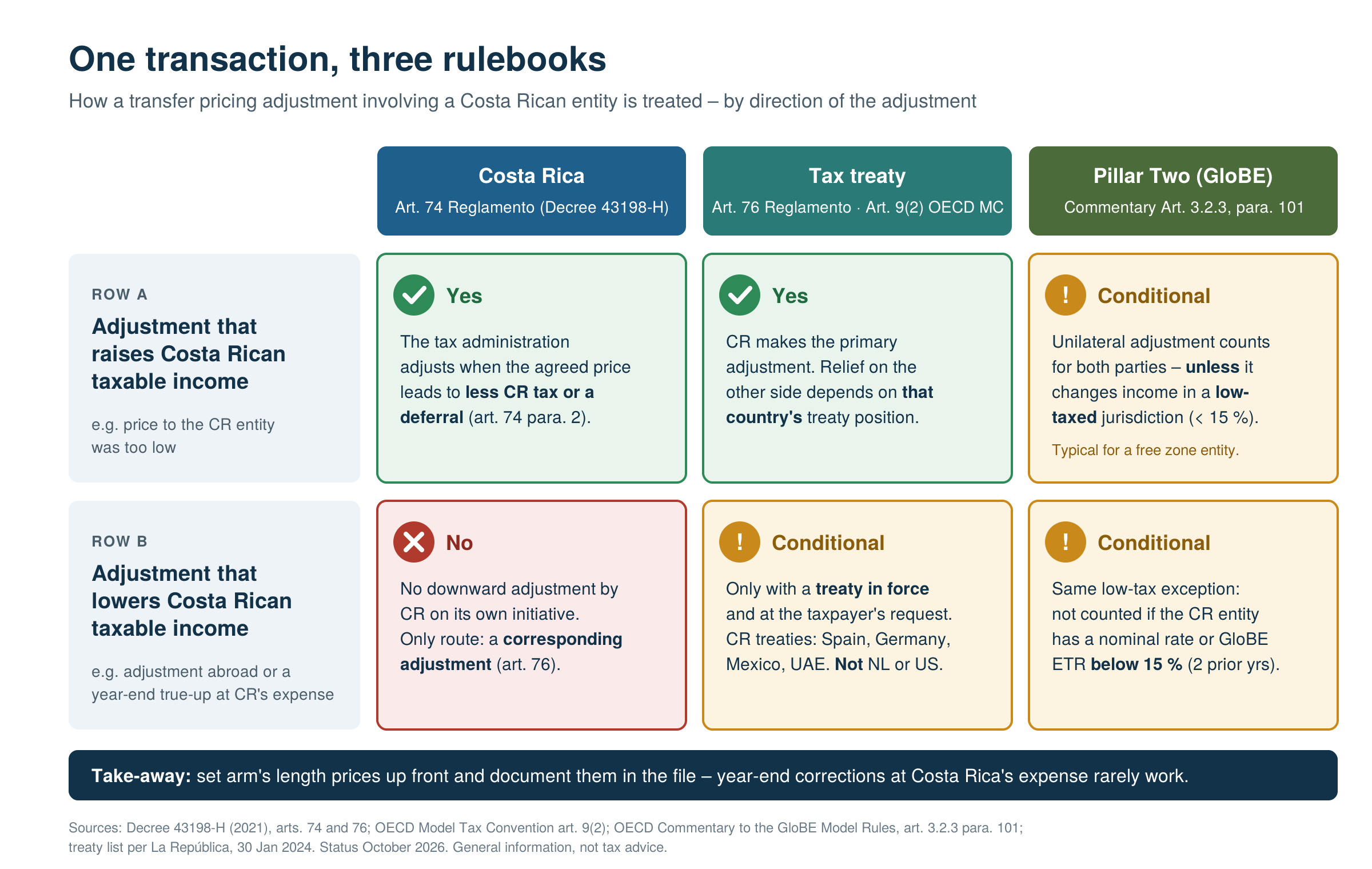
The global minimum tax has its own rule for price corrections between group companies. In principle it is symmetrical: if the Netherlands moves USD 200,000 of profit from Costa Rica to the Netherlands, the minimum-tax calculation moves it too. In our example:
Before the Dutch correction
After
Costa Rican profit for the minimum tax
1,000,000
800,000
Top-up tax (15%)
150,000
120,000
Costa Rican profit in the Costa Rican tax return
1,000,000
1,000,000 (Costa Rica does not follow)
So the minimum tax follows the Dutch correction – Costa Rica’s own tax law does not. The global rule turns out to be fairer than the local one.
There is one exception. If the correction is made in Costa Rica itself on a low-taxed free zone company, the minimum tax does not mirror it on the other side. The aim is to stop low-tax countries from moving profit out of the minimum tax.
Three rulebooks, three different answers to the same transaction:
6. What a company can do
Get the prices right from the start. Correcting afterwards, at Costa Rica’s expense, rarely works – Costa Rica will not follow.
Know which way each price could move. Would a correction raise or lower the Costa Rican profit? Only the first is a risk in Costa Rica; the second is a risk of double taxation elsewhere.
Check for a tax treaty with each country the company does business with. No treaty means no way out.
Calculate the minimum tax effect. Who would collect the top-up tax – and does the 2026 arrangement for US groups apply?
Keep the evidence in the file. Costa Rican judges decide on what is in the file. In the GlaxoSmithKline case (Supreme Court, 2022), the company lost because it could not support its explanation with figures during the audit. Documentation must also be available in Spanish.
7. Open questions
Will Costa Rica sign more tax treaties? The OECD recommends it.
Will Costa Rica introduce its own minimum tax, so that the top-up stays in the country – and US-owned and European-owned companies are treated alike?
Is the one-way rule in Article 74 legally sound? It is in a regulation, not in the law itself. We have found no court ruling on this yet.
Sources
Executive Decree No. 43198-H, Reglamento de la Ley del Impuesto sobre la Renta (2021), arts. 74, 76 and 82.
Law No. 7092, Ley del Impuesto sobre la Renta, art. 81 bis.
Code of conduct on transfer pricing documentation for associated enterprises in the European Union (EU TPD) Without prejudice to the respective spheres of competence of the Member States and the Community, this Code of Conduct concerns the implementation of standardised and partially centralised transfer pricing…